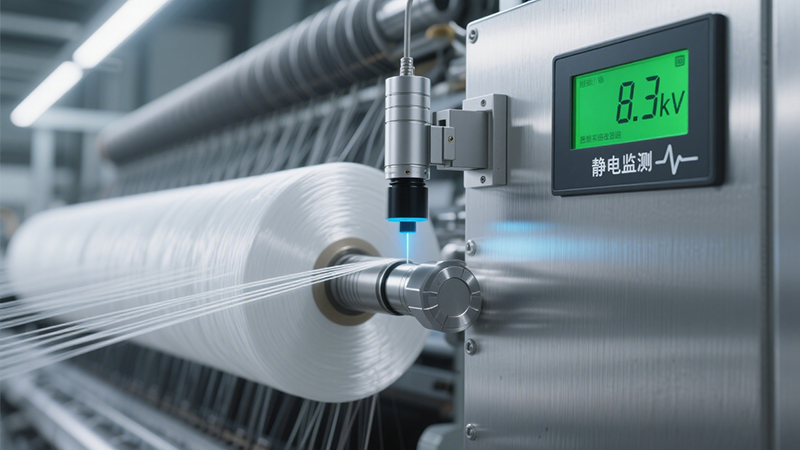
The main advantages of adding static electricity detection are summarized in the following key aspects:
Significantly Improve Product Quality
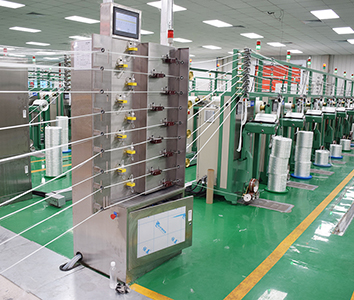
Reduce fuzz and filament breakageDuring the fiber drawing process, filaments carrying the same static charge repel each other, causing fiber dispersion and vibration. This easily leads to friction against yarn guides and produces fuzz; in severe cases, it causes breakage and defects. Static electricity detection helps identify static buildup trends in advance for timely intervention, ensuring the integrity and bundling stability of the fiber strand.
Prevent poor bondingIn downstream processes such as chopping and mat production, static-charged fibers may entangle or repel one another, resulting in uneven distribution and compromising the uniformity and bonding performance of products including glass wool and fiber mats. Controlling static electricity ensures uniform product structure and consistent mechanical properties.
Enhance downstream processabilityGlass fiber yarns with low static charge run more smoothly in weaving, braiding and other post-processing, with less fuzz, slippage or entanglement, supporting the production of higher-quality textiles and composite materials.
2. Greatly Boost Production Efficiency
Lower breakage rateAs mentioned above, static electricity is one of the main causes of filament breakage. Reducing breakage greatly stabilizes the drawing operation, cuts down downtime for handling breakages, and directly improves equipment operating efficiency and production capacity.
Increase production line speedWith effective static control, the production line can run stably at higher speeds without risks caused by excessive static from high-speed friction, thus increasing output.
Reduce downtime for cleaning and maintenanceStatic electricity causes glass fiber scraps and dust to adhere to equipment rollers, yarn guides, frames and even workshop walls. This not only pollutes the environment but also requires frequent shutdowns for cleaning. By controlling static electricity, dust adhesion is greatly reduced, extending continuous operating time of the equipment.
3. Improve Production Safety and Working Environment
Eliminate fire hazardsFine organic particles (such as sizing agent components) and dust are generated during glass fiber production. When static charge accumulates to a certain level, electric sparks may occur, posing risks of ignition and explosion in the presence of combustibles. Static electricity detection and control systems serve as important proactive safety measures to effectively prevent such serious accidents.
Upgrade the working environmentReducing dust diffusion caused by static adhesion keeps the workshop cleaner, benefits employee health, and complies with environmental protection and occupational safety requirements.
4. Enable Predictive Maintenance
Equipment condition diagnosis
An abnormal rise in static levels is often an early indicator of equipment faults, for example:
Worn or non-rotating yarn guides causing increased friction
Misaligned or damaged sizing applicators
Poor equipment grounding
Uncontrolled environmental humidity (low humidity is a major cause of static electricity)
By continuously monitoring static values as a key parameter, potential issues can be detected and resolved before they escalate, shifting from “reactive maintenance” to “predictive maintenance” and avoiding greater losses.







 English
 简体中文
简体中文